

%2520Medium.jpeg&w=3840&q=75)
Walking into a nursery for the first time can feel overwhelming. You're trying to get a sense of the place, notice whether the children look happy, and figure out if it's right for your family. But beyond first impressions, you need to ask the right questions to understand how the nursery operates, what your child will experience there, and whether it aligns with your values and needs.
Walking into a nursery for the first time can feel overwhelming. You're trying to get a sense of the place, notice whether the children look happy, and figure out if it's right for your family. But beyond first impressions, you need to ask the right questions to understand how the nursery operates, what your child will experience there, and whether it aligns with your values and needs.
The nursery visit is your chance to gather information that won't appear on their website or in their marketing materials. You'll want to understand their approach to learning, how they handle challenging moments, but you'll also need practical information about costs, flexibility, and what happens on a typical day.
The questions you ask during a nursery visit should cover three main areas: the staff and their qualifications, the daily experience your child will have, and the practical logistics that affect your family. At Nuuri, we have first-hand experience of navigating this daunting step, so our guide walks you through the most important questions to ask, organised by category, so you can conduct a thorough visit and leave feeling confident about your choice.
Questions About Staff and Qualifications
The people caring for your child are the most important factor in choosing a nursery. When you’re choosing a nursery, you want to know the people there are qualified, experienced, and genuinely committed to supporting your child's development.
You should ask about staff turnover and continuity. You need to know how long staff typically stay at the nursery, and whether your child will have a consistent key worker, or if staff change frequently. A key worker is a member of staff who has a special responsibility for your child's wellbeing and development; having the same key worker throughout your child's time at the nursery helps build a secure attachment and ensures someone knows your child really well.
Check about staff training and development. You’ll want to know if the nursery invests in ongoing training for staff and what topics they cover. Good nurseries provide regular training on topics like child development, safeguarding, behaviour management, and new approaches to early years education. This shows they're committed to keeping their practice up to date.
It's also worth finding out how the nursery recruits staff and what checks they carry out. All staff working with children must have a Disclosure and Barring Service (DBS) check. Ask whether the nursery carries out enhanced DBS checks and whether they verify references thoroughly. This is a safeguarding issue and you want to know they take it seriously.
What to Ask About Nursery Staff Qualifications
Start by asking about staff qualifications. What level of training do the staff have? Are they trained in early years education, first aid, safeguarding, and child protection? These things matter because better-qualified and well-trained staff are more effective at supporting children’s development, wellbeing, and safety.
In England, under the statutory Early Years Foundation Stage (EYFS) framework, nurseries must ensure that staff working with children hold appropriate childcare qualifications. At least one member of staff in each room must have a Level 3 qualification (e.g., Diploma in Childcare and Education or equivalent), and settings often employ staff with higher qualifications such as Level 4 or Level 5 diplomas or degrees in early childhood education. Staff must also receive ongoing training in areas like safeguarding, health and safety, and first aid to meet EYFS requirements
In Scotland, early years staff working in Early Learning and Childcare (ELC) settings follow standards set by the Care Inspectorate and are typically required to register with the Scottish Social Services Council (SSSC) at an appropriate practitioner level. Practitioners are expected to hold, or be working towards, relevant qualifications (often at SCQF Level 7 or above) that align with the Scottish Credit and Qualifications Framework, and complete a national induction when they start in post.
In Wales, early years practitioners need a recognised childcare qualification to work unsupervised or in leadership roles, typically Level 3 or above in early years/childcare. Entry level roles might start at Level 2 with a requirement to work towards higher qualifications, and ongoing professional learning is expected.
Across all three nations, staff should also have up-to-date safeguarding training and appropriate first aid qualifications, and providers should invest in regular continuing professional development (CPD). In England, only staff with the correct first aid qualification count in nursery ratios.
Questions About Daily Routines and Activities
Understanding what your child will actually do during the day is crucial. You want to know whether the nursery's approach to learning and play matches your values, and whether your child will be engaged and happy.
Find out what a typical day looks like, and make a list of questions based on that. For example:
- What time do children arrive and leave?
- What activities happen throughout the day?
- When are snacks and meals, or outdoor play?
- When do children sleep or have quiet time?
Understanding the structure of the day helps you prepare your child and know what to expect.
Getting information about the curriculum and learning approach is important too. Check what the nursery uses as a learning framework: e.g. a particular educational philosophy, such as Montessori, Reggio Emilia, or Forest School? Check what activities they offer to support learning in different areas, such as language, maths, physical development, and creative play. Some nurseries are quite structured and formal, while others are more child-led and play-based. Understanding their approach helps you decide if it's right for your child.
Ask about outdoor play. How much time do children spend outside? What facilities do they have? Do they go outside in all weathers? Outdoor play is crucial for children's physical development, wellbeing, and learning. Good nurseries prioritise outdoor time and have well-resourced outdoor spaces.
Make a note of how the nursery supports children's emotional development and wellbeing. How do they help children settle in, or children with nursery separation anxiety? Ask what strategies they use to help children manage big emotions; this is particularly important if you're worried about anxiety or if your child finds transitions difficult.
Ask about how the nursery communicates with parents about your child's day. They might use an app, written notes, or verbal handovers, and how often you get updates can vary too. Will you receive photos or observations of your child learning? Good communication helps you feel connected to your child's day and understand their development.
%20Medium.jpeg)
Questions About Safety and Safeguarding
You need to feel confident that your child will be safe and well cared for. Ask about the nursery's safeguarding policies and procedures.
Important questions here:
- What security measures do they have?
- How do they control access to the building?
- How do they manage arrival and departure?
- What happens if someone unauthorised tries to collect your child?
- Ask about their procedures for keeping children safe during outdoor play and on trips.
Ask about their health and safety procedures. Learn what happens if your child is ill, and find out which illnesses require children to stay home. How do staff handle accidents or injuries, and do they have first aid trained staff on site at all times? What's their procedure for administering medication?
Ask about their safeguarding policy. What training have staff received in safeguarding? What would they do if they had concerns about a child's welfare? How do they report concerns? Understanding their safeguarding approach gives you confidence that they take child protection seriously.
Ask about their behaviour management approach. How do they handle challenging behaviour? Do they use positive discipline strategies? What's their policy on physical punishment (which should be a clear no)? How do they help children learn to manage their behaviour and emotions?
Questions About Practical Matters
You also need to understand the practical side of using the nursery. These questions affect your day-to-day experience and your budget.
Ask about costs and what's included. What's the hourly or daily rate? Are there any additional charges for meals, snacks, nappies, activities, or trips? What's their policy on childcare funding (15 hours, 30 hours, Tax-Free Childcare)? How do they handle top-up fees? Ask for a clear breakdown so you understand the true cost.
Ask about their notice period. If you need to leave, how much notice do you need to give? What's their policy if you want to reduce hours? Do you have to pay fees during your notice period? Understanding this upfront prevents surprises if your circumstances change.
Ask about flexibility and opening hours so you can plan ahead. Important questions to ask:
- What hours are they open?
- Can you do flexible hours or do you have to commit to set days?
- What happens during school holidays?
- Do they close for bank holidays?
- Can you take unpaid weeks if you need to?
Understanding their flexibility helps you work out if they fit your schedule.
Ask about their settling-in process. How many settling-in sessions do they offer, and can you stay with your child during settling in? Find out how the nursery staff help children adjust to being away from their parents. A good settling-in process makes a huge difference to how quickly your child settles.
It’s also good to learn about their communication with parents (it’s also worth checking with other customers if you can). Think about how often you can call to check on your child, if they have a policy about parents visiting during the day, and how they handle concerns or complaints. Good communication and an open-door policy help you feel involved and confident.
Making the Most of Your Visit
%20Medium.jpeg)
Beyond asking questions, pay attention to what you observe during your visit. Make a checklist to make sure you observe everything you need to.
- Are the children happy and engaged?
- Do they look comfortable with the staff?
- Is the environment clean, safe, and well-resourced?
- Do the staff interact warmly with the children?
- Are there interesting activities and learning opportunities?
- What toys and equipment can you see?
Trust your instincts about whether the nursery feels right for your family. Take notes during or after your visit so you can compare different nurseries. It's easy to forget details after visiting several places. Writing things down helps you remember and compare.
Don't be afraid to ask follow-up questions if something isn't clear. A good nursery will be happy to explain their approach and answer your questions in detail. If a nursery seems defensive or unwilling to answer questions, that's a red flag.
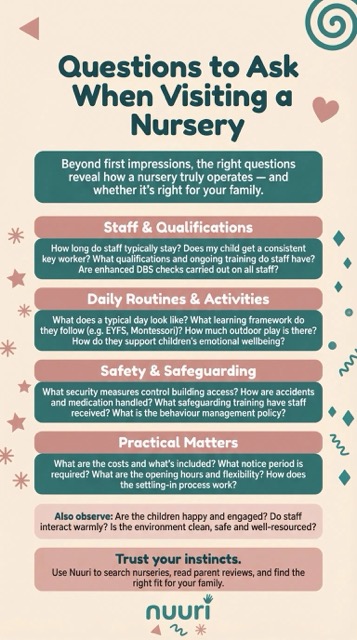
Finding the Right Nursery for Your Family
Choosing a nursery is one of the biggest decisions you'll make as a parent. Asking the right questions during your visit helps you gather the information you need to make a confident choice.
You want a nursery where your child will be happy, safe, and supported to learn and develop. Use Nuuri to search for nurseries in your area, read parent reviews, and check Ofsted ratings. Then visit in person, ask these questions, and trust your instincts about whether it's the right fit for your family.
Start your search on Nuuri today and find a nursery that's right for your child.
Find a nursery
Search by location or nursery name
Frequently asked questions
The most important question is about the key worker system and continuity of care. Knowing your child will have a consistent adult who knows them well makes a huge difference to their wellbeing and development.
Visit at least 2-3 nurseries so you can compare. This helps you understand what's available in your area and what feels right for your family. Some parents visit more if they're unsure or if options are limited.
If a nursery is unwilling or defensive about answering your questions, that's a concern. A good nursery will be transparent and happy to explain how they work. Consider visiting another nursery.
Absolutely. Ask how the nursery celebrates diversity, supports children from different backgrounds, and ensures all children feel included and valued. This is important for all children's development and wellbeing.
Yes. If your child has allergies or specific health needs, ask how the nursery manages these during outdoor play and activities. Ask about their procedures for keeping children with allergies safe.
%20Medium.jpeg)
%20Medium.jpeg)